
From village shops and milk deliveries to modern offices, the changing face of a familiar Heswall landmark
Anyone who has lived in Heswall for a number of years will have witnessed some remarkable changes. Familiar shops have disappeared, businesses have come and gone, and buildings that once served one purpose have found an entirely new lease of life.
Yet, amid all those changes, some landmarks remain reassuringly familiar.
One such building is Whitfield Buildings on Pensby Road, now home to Whitfield Business Hub. Dating from the 1920s, this substantial parade of commercial premises has been part of everyday life in Heswall for approximately a century.
Today, it provides offices and business accommodation, but look a little further into its past and you’ll discover a fascinating connection with the village’s former shops, farms and dairies.
There are also some intriguing local stories, including a possible underground stream and a dairy with the rather charming name of Beehive.
When Heswall Was a Village of Shopkeepers
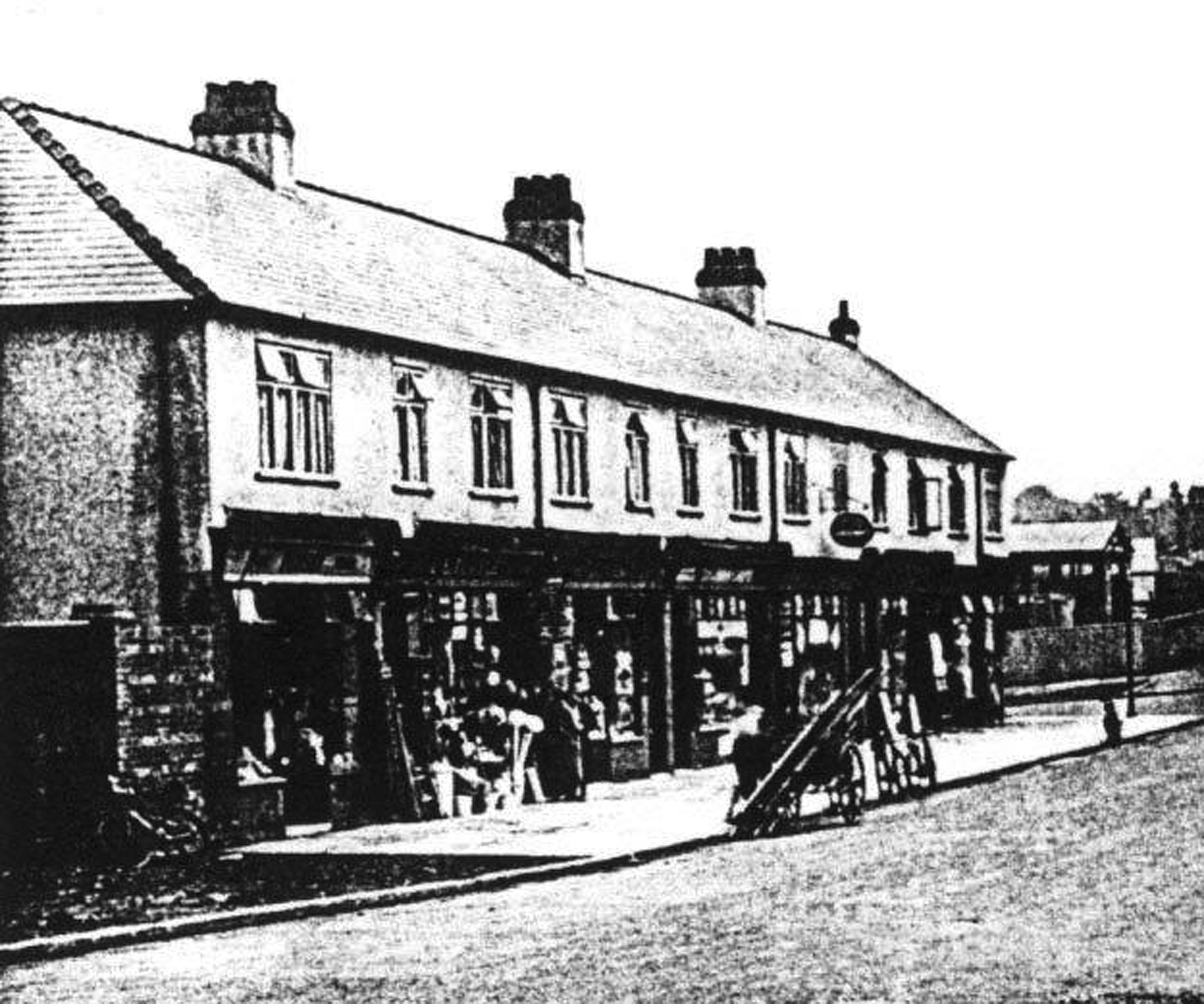 To appreciate the history of Whitfield Buildings, it’s worth imagining Heswall as it was a hundred years ago.
The motor car was becoming increasingly common, but village life still revolved around local shops and tradespeople. Most families purchased their provisions from independent businesses, often visiting several different shops during the week.
There were no large supermarkets offering everything under one roof. Instead, residents might visit the butcher for meat, the greengrocer for vegetables, the fishmonger for something for supper and the dairy for fresh milk.
Whitfield Buildings was home to an interesting collection of these businesses.
Local historians Jenny McRonald and Roger Lane, writing in Heswall Magazine in 2016, identified several traders who occupied the premises over the years.
There were Garners the greengrocers, Calverleys the grocers, Tunley’s chemist, Jones the butcher, Firths the fishmongers and fish-and-chip shop, and Charles Jones, who operated a hardware business.
Not all these businesses necessarily traded at the same time, but together they give us a picture of Whitfield Buildings as an important part of Heswall’s shopping community.
Old photographs of the premises show traditional shopfronts beneath the familiar first-floor windows, with goods displayed for passing customers and people gathering along the pavement.
It must have been a lively little commercial centre, with deliveries arriving throughout the day, shopkeepers chatting to regular customers and local residents exchanging news as they went about their shopping.
For those who remember Heswall in the 1950s, 60s and 70s, some of these names may still be familiar.
A Dairy at Whitfield Buildings
One particularly interesting discovery concerns a business operated by Thomas Henry.
Research published by local historian Greg Dawson in December 2022 identifies Thomas Henry of Whitfield Buildings as one of Heswall’s dairy suppliers during the 1930s.
Milk was an essential part of everyday village life, and the local dairy was a familiar institution.
Before domestic refrigeration became widespread, fresh milk was generally purchased or delivered frequently. Milk rounds were a daily feature of many communities, with deliveries made by handcart, horse-drawn vehicle and, later, motorised vans.
Some customers would take their own jugs to a dairy, while others relied on the familiar milkman arriving at the doorstep.
Although we don’t know precisely how Thomas Henry operated his business, the fact that a dairy supplier was based at Whitfield Buildings offers a fascinating glimpse into the building’s earlier commercial life.
Where today someone might arrive for a business meeting, a resident of 1930s Heswall could once have called in for a pint of milk.
It is also worth remembering that, in those days, milk was often produced much closer to the communities it served. The surrounding area still retained strong agricultural connections, with farms and smallholdings supplying the growing population.
The Curious Story of Beehive Dairy
The dairy connection doesn’t end at Whitfield Buildings.
A short distance away, on Whitfield Lane, another dairy business operated under the delightful name of Thompson’s Beehive Dairy.
Its premises stood on land now occupied by Heswall Primary School.
Despite the name, there is currently no evidence that the business was involved in keeping bees or producing honey. Beehive appears to have been the dairy’s trading name, perhaps chosen because of the traditional association between bees, industry and hard work.
Whether the Thompson family kept their own cows on the property or obtained milk from surrounding farms remains uncertain, although the business was clearly part of Heswall’s once-thriving local dairy trade.
What makes this particular story rather lovely is that the name has survived long after the dairy itself disappeared.
When Heswall Primary School moved to its present Whitfield Lane site in 1976, it was built on the former Beehive Dairy land.
The school’s connection with its predecessor is still reflected in its identity. A bee features in the school emblem, its before-school and after-school provision is called Beehive, and a newer specialist provision bears the name Honeycomb Class.
So, although the milk churns and dairy deliveries have long since disappeared, the Beehive name continues to be part of everyday life in Heswall.
It’s a rather charming example of how local history can survive in unexpected ways.
Before the Shops Came the Fields
The land surrounding Whitfield Buildings has a history stretching back considerably further than the building itself.
Long before the shops appeared, much of this part of Heswall consisted of farmland, market gardens, cottages and open common land.
Historical research has identified a nineteenth-century farm known as Rose Cottage, owned in 1851 by Thomas Price. His holding included approximately seven acres of land in the area between Sandy Lane, Pensby Road and Whitfield Lane, together with cottages and agricultural buildings.
At that time, Heswall was still a predominantly rural settlement, although the foundations of the modern village were beginning to emerge.
Whitfield Lane itself has roots in the area’s agricultural history, with local records connecting its development to the nineteenth-century enclosure of common land.
And then there is Whitfield Common.
Today, it’s a familiar green space, but historically it formed part of the much larger Barnston Common, where local people exercised grazing rights and livestock could roam.
In 1933, William Hulme Lever, the second Viscount Leverhulme, donated Whitfield Common for public use, helping preserve a little of the area’s rural character as Heswall expanded.
It’s easy to forget that roads now surrounded by houses, offices and shops once served farms and fields, and that parts of modern Heswall were still recognisably agricultural well into the nineteenth century.
The Mystery of the Underground Stream
There is another intriguing story associated with Whitfield Buildings, although this one remains something of a mystery.
Local recollections suggest that an underground stream may run beneath or close to the building, possibly connected with the dairies that once operated in the area.
It is certainly an interesting possibility.
A reliable water supply would have been important to agricultural activities, particularly dairies, where water was needed for cleaning equipment and maintaining hygiene.
Historical accounts identify wells in the wider neighbourhood, while more recent planning documents confirm the existence of a natural watercourse in the Whitfield Lane area.
Whether that watercourse passes beneath Whitfield Buildings, or whether it had anything to do with either dairy business, has yet to be established.
It is possible that a stream was diverted or culverted as Heswall developed, something that happened frequently as villages expanded into towns.
Alternatively, the story may relate to an old spring or well rather than a flowing underground stream.
Perhaps someone reading this article remembers hearing about it from their parents or grandparents, or has come across evidence in old property documents.
For now, it remains one of the more intriguing unanswered questions in the building’s history.
Changing Times at Whitfield Buildings
 As the twentieth century progressed, Heswall continued to change.
Independent shops increasingly faced competition from supermarkets and larger retailers. Shopping habits evolved, more families owned cars, and the traditional village shopping parade gradually became less central to everyday life.
Like many commercial buildings, Whitfield Buildings adapted.
Over time, premises that had once housed retailers began accommodating offices and other businesses, reflecting the changing needs of the local economy.
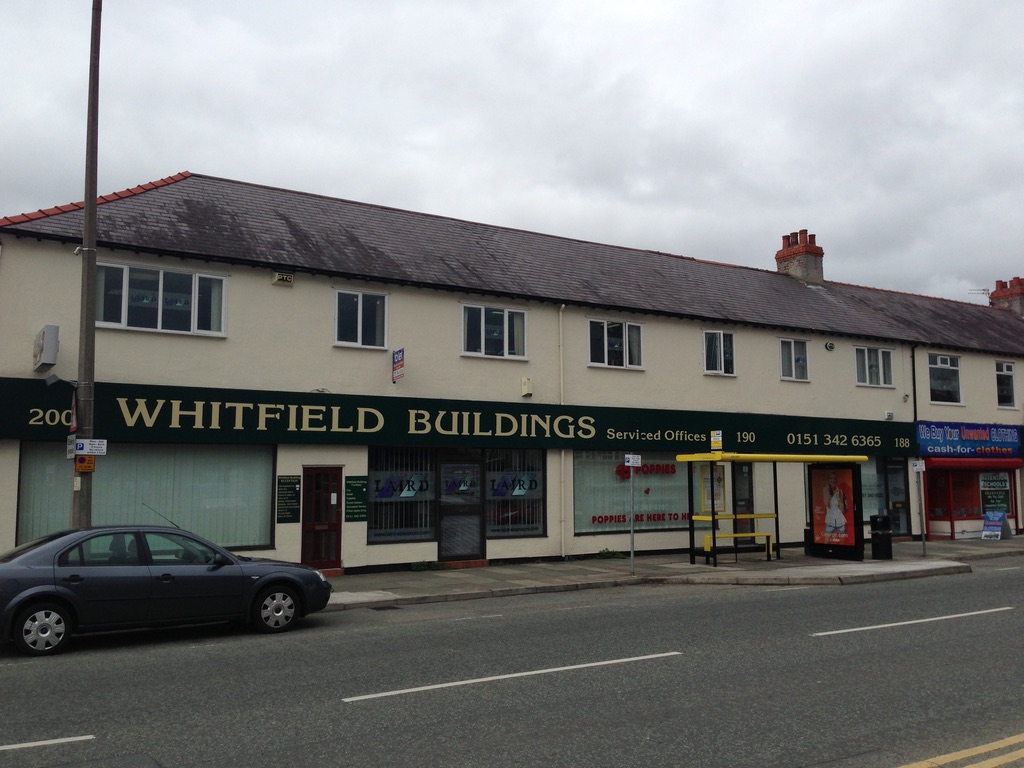
For many years, the building retained its familiar cream-coloured exterior, with a large green and gold sign proudly displaying the name WHITFIELD BUILDINGS across the frontage.
Photographs from this period show a mixture of offices, shops and vacant units. Laird Assessors was already established at the premises, while other businesses, including a computer retailer, occupied parts of the parade.
By then, the building was showing its age.
Some areas of the exterior render had deteriorated, shopfronts varied considerably in appearance, and the overall frontage reflected decades of alterations and changing occupants.
Nevertheless, the underlying building remained remarkably similar to the one visible in the earliest photograph, with its long pitched roof, distinctive chimneys and regularly spaced upper-floor windows.
A New Chapter for a Familiar Building
In more recent years, Whitfield Buildings has undergone extensive refurbishment and modernisation, emerging as Whitfield Business Hub.
The work included improvements to the building’s exterior, glazing, heating and internal facilities, together with the creation of more contemporary office accommodation.
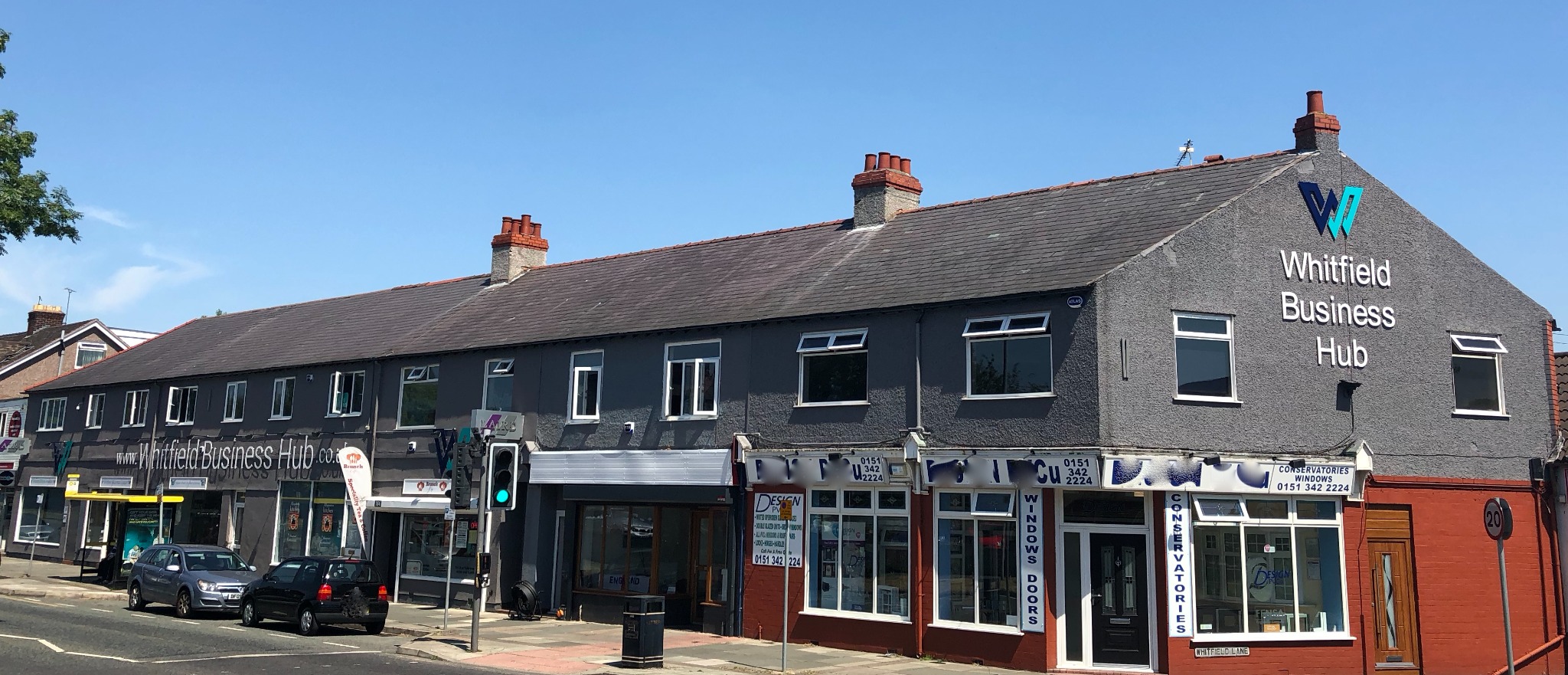 The familiar cream frontage gave way to a smart charcoal-grey exterior, with new signage and a more consistent appearance along the parade.
Further expansion brought additional accommodation into the hub, allowing it to provide premises for a growing range of businesses.
Yet, despite the transformation, the building’s original character remains readily identifiable. The roofline, chimneys and first-floor proportions are remarkably similar to those visible in the old black-and-white photograph.
Unlike many buildings that have disappeared altogether as towns have developed, Whitfield Buildings has survived by changing with the times. And perhaps the most interesting aspect of its story is that its fundamental purpose has remained remarkably consistent.
For approximately a century, the building has provided a home for independent businesses serving Heswall and the surrounding area.
A hundred years ago, the occupants might have included a butcher, grocer, chemist or dairy supplier. Today, they are more likely to be professional services, consultants and other modern businesses.
The goods and services may have changed, but the building continues to support local enterprise and employment. There is something rather satisfying about that continuity.
Do You Remember Whitfield Buildings?
One of the pleasures of looking into local history is discovering how much information survives in people’s memories.
Photographs, old receipts, newspaper advertisements and family stories can all help piece together a picture of Heswall that might otherwise be lost.
We’ve been fortunate to uncover several photographs of Whitfield Buildings taken over the years, including a particularly interesting black-and-white image showing the original shops.
Unfortunately, the precise date of that photograph remains unknown, as do the identities of the people standing outside.
Perhaps someone reading this article recognises the scene.
We would be delighted to hear from anyone who remembers the original shops, particularly Garners, Calverleys, Tunley’s, Firths or Charles Jones’s hardware business.
We’re also interested in hearing more about Thomas Henry’s dairy at Whitfield Buildings, Thompson’s Beehive Dairy on Whitfield Lane and, of course, the mysterious underground stream.
Perhaps a parent or grandparent worked in one of the shops, or you remember visiting them as a child.
Sometimes the smallest recollections, a shopkeeper’s name, a favourite purchase or a remembered conversation, can help preserve a little piece of local history.
As Whitfield Buildings moves through its second century, it’s worth remembering that its story is really the story of the people who have worked, shopped and lived around it.
The names above the doors may have changed, but the building remains a familiar part of Heswall.
And perhaps, a hundred years from now, somebody will be looking at photographs of Whitfield Business Hub as it stands today, wondering what life was like in the early twenty-first century.
Hopefully, they’ll have a few more photographs, and a few fewer mysteries, to help them.